
Prediction of a Global Low-Frequency Space-Time Oscillation (~0.06 Hz)
DOI:
https://doi.org/10.14331/ijfps.2026.330180Keywords:
space–time structure, gravitational background mode, metric pulsation, fundamental pressure, Foucault pendulum, Coriolis forceAbstract
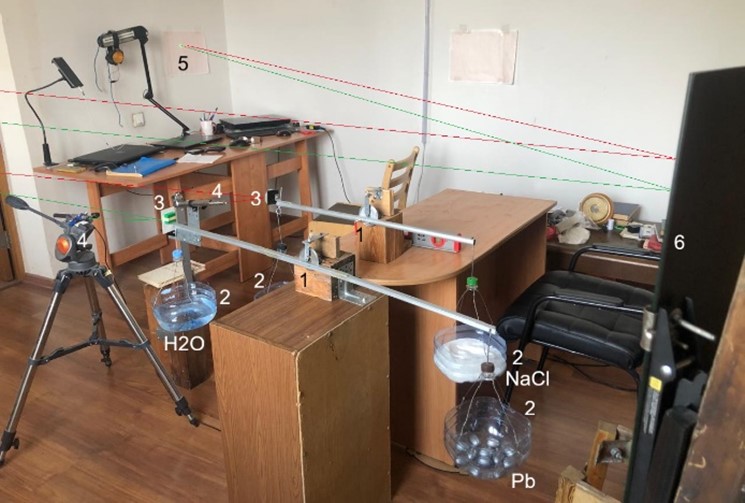
A low-frequency pulsation of the metric structure of space–time with a characteristic frequency of approximately 0.06 Hz is theoretically examined within a structural–informational framework. This oscillatory mode is considered as a global background feature consistent with experimental data within the proposed framework, which may influence the dynamics of particles and macroscopic objects. The phenomenon is treated as having a gravitational origin and is associated, in the proposed model, with variations in the energy density of space–time. The characteristic frequency emerges from the dynamics of a background space–time lattice, representing a deeper structural level governing gravitational interaction. Potential signatures are explored using data of different pendulums, whose oscillation periods and energetic relations are found to be consistent with excitation by such a global mode within the limits of the model. The approach provides a conceptual structural–informational perspective on inertia, mass, and gravitational dynamics.
Downloads
References
Aizerman, M. A. (1980). Classical mechanics. Nauka.
European Space Agency. (2024). LISA: Detecting and observing gravitational waves. ESA Science.
Landau, L. D., & Lifshitz, E. M. (1976). Mechanics (3rd ed.). Pergamon Press.
Li, Z., et al. (2010). Pressure ulcer, pressure and flow motion. In Biomechanics: From molecules to man (Chap. 20, p. 231). World Scientific.
Linck, R. F. (2013). Foucault’s pendulum as a classical analog for the electron spin state (Master’s thesis). San José State University.
Rekhtina, A. G., et al. (2010). Coincidence of geomagnetic pulsations Pc3 with microcirculatory oscillations. Space Research Institute (IKI RAS), Moscow.
Published
Issue
Section
License
Copyright (c) 2026 International Journal of Fundamental Physical Sciences

This work is licensed under a Creative Commons Attribution-NoDerivatives 4.0 International License.


 WorldCat
 Scilit
 ORCID
 Dimensions
 Mendeley
 Lincoln Library
 Cambridge iDiscover


