
Do The Many Problems of Contemporary Cosmology Have a Single Cause? A Research Program
DOI:
https://doi.org/10.14331/ijfps.2025.330177Keywords:
cosmological tensions, effective speed of light, cosmological refractive index, Shapiro effect, general relativity, ΛCDM model, dark matter, dark energyAbstract
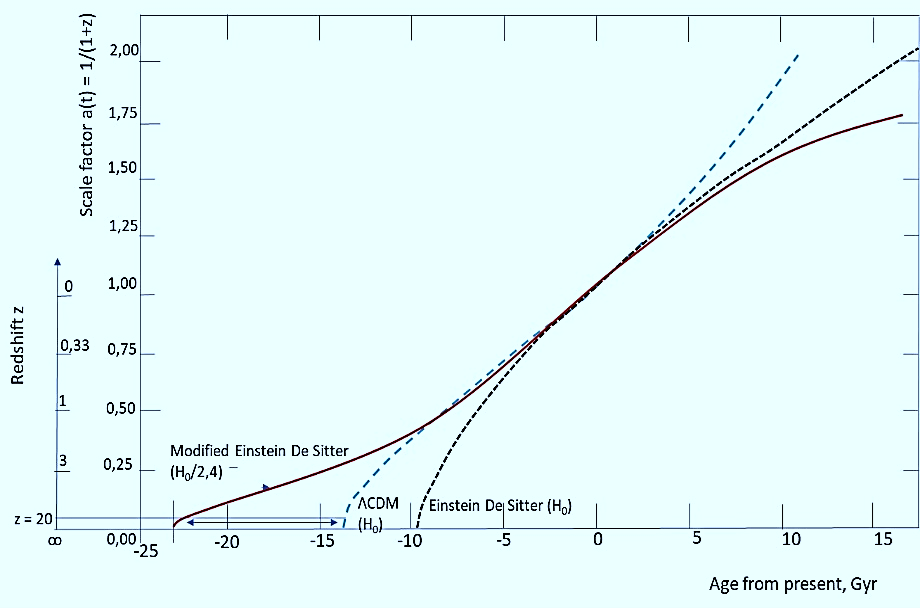
A number of key predictions of the standard cosmological model are in tension with observations, including the apparent need for dark matter and dark energy, the Hubble tension, the S₈ tension, and the existence of seemingly “impossible” early galaxies. Together, these issues imply that only about 5% of the Universe’s matter–energy content is understood, yet they are typically examined in isolation. In this work, we explore a single unifying hypothesis: these diverse discrepancies may arise from a systematic misestimation of the speed of light on cosmological scales. We propose that the effective cosmological light speed is reduced by a factor of approximately 2.4 relative to its local vacuum value. This framework introduces no new forms of matter, fields, or laws; instead, it is grounded in general relativity through an extension of the Shapiro effect. From this assumption, we derive a set of quantitative predictions and compare them with observations across roughly a dozen major cosmological problems. The agreement obtained is consistently favorable, and the coherence of the approach strengthens its plausibility. While it may be premature to dismiss the standard model outright, our results suggest that its interpretation par-ticularly its assumption that the speed of light is universally equal to its local value requires reconsideration. We advocate pursuing this hypothesis in parallel with the ΛCDM model, as it offers a simple, unified alternative to the numerous ad hoc components currently invoked.
Downloads
References
Aubert, D. (2019). Cosmologie physique. Ellipses. [Google Scholar]
Buchert, T. (2012). Invisible universe or inhomogeneous universe? The problems of dark matter and dark energy. In T. Lepeltier & J.-M. Bonnet-Bidaud (Eds.), Un autre cosmos? (pp. 99–119). Vuibert.[Google Scholar]
de Vaucouleurs, G. (1971). The large-scale distribution of galaxies and clusters of galaxies. Publications of the Astronomical Society of the Pacific, 83(492), 113–143.[CrossRef] [Google Scholar]
Gupta, R. P. (2023). JWST early Universe observations and ΛCDM cosmology. Monthly Notices of the Royal Astronomical Society, 524(3), 3385–3395.[CrossRef]: [Google Scholar]
Guy, B. (2011). Thinking time and space together. Philosophia Scientiae, 15(3), 91–113.[Google Scholar]
Guy, B. (2019). ESPACE = TEMPS. Dialogue sur le système du monde. PENTA Éditions.[Google Scholar]
Guy, B. (2022). Revisiting the status of the “speed of light” and examining some cosmological problems. HAL: hal-03860051.[HAL] [Google Scholar]
Guy, B. (2024a). A diamond universe. International Journal of Fundamental Physical Sciences, 14(2), 24–40 [Google Scholar]
Guy, B. (2024b). Refreshing the theory of relativity. Intentio, 5, 9–55 [Google Scholar]
Guy, B. (2024c). On the interdependence of the values of the gravitational constant, the speed of light, mass densities, and system sizes. [HAL] [Google Scholar]
Guy, B. (2025). (Finite-time) thermodynamics, hyperbolicity, Lorentz invariance: Study of an example. Entropy, 27(7), 700.
[CrossRef] [Google Scholar]
Jiao, Y., Hammer, F., Wang, H., Wang, J., Amram, P., Chemin, L., & Yang, Y. (2023). Detection of the Keplerian decline in the Milky Way rotation curve. Astronomy & Astrophysics, 675, A13.[CrossRef] [Google Scholar]
Leconte-Chevillard, G. (2024). Histoire d’une science impossible: Cosmologie et épistémologie de 1917 à nos jours. Éditions de la Sorbonne.[Google Scholar]
Lepeltier, T. (2014). La face cachée de l’univers: Une autre histoire de la cosmologie. Seuil.[Google Scholar]
Lepeltier, T., & Bonnet-Bidaud, J.-M. (Eds.). (2012). Another cosmos? Vuibert.[Google Scholar]
Maeder, A. (2017). An alternative to the ΛCDM model: The case of scale invariance. The Astrophysical Journal, 834(2), 194. [CrossRef] [Google Scholar]
McGaugh, S. S. (2014). The third law of galactic rotation. Galaxies, 2(4), 601–622.[CrossRef] [Google Scholar]
McGaugh, S. S., Lelli, F., & Schombert, J. M. (2016). The radial acceleration relation in rotationally supported galaxies. Physical Review Letters, 117(20), 201101.[CrossRef] [Google Scholar]
Paturel, G. (2023). The mass of our galaxy. Les Cahiers Clairaut, 183, 26–32.[Google Scholar]
Poincaré, H. (1905). The value of science. Flammarion.[Google Scholar]
Rey, A. (1905). La valeur de la science. JSTOR edition. [Google Scholar]
Seifert, A., Lane, Z. G., Galoppo, M., Ridden-Harper, R., & Wiltshire, D. L. (2024). Supernovae evidence for foundational change to cosmological models. Monthly Notices of the Royal Astronomical Society, 537, 55–75. [CrossRef] [Google Scholar]
Published
Issue
Section
License
Copyright (c) 2025 International Journal of Fundamental Physical Sciences

This work is licensed under a Creative Commons Attribution-NoDerivatives 4.0 International License.


 WorldCat
  Scilit
  ORCID
ORCID  Dimensions
  Mendeley
  Lincoln Library
  Cambridge iDiscover


